
Center for Imagination, Reflective Development, and AI Futures
An interdisciplinary research laboratory dedicated to understanding how individuals develop the capacity for imagination, abstract thinking, ethical foresight, and innovation in the Age of Artificial Intelligence.
Vision
“To create the world’s leading research and development laboratory dedicated to cultivating human imagination, ethical reflection, and creative consciousness in the era of artificial intelligence.”

Mission
- Develop scientifically validated models of imaginative and reflective development
- Investigate how individuals and societies generate transformative ideas
- Design scalable educational frameworks that accelerate movement toward advanced imaginative maturity
- Integrate humanities, creativity, ethics, and STEM into future learning systems
- Prepare future generations to responsibly shape technological, economic, and social transformation
A national and international hub
Multiple fields, one laboratory
Evidence-based systems that prepare future generations for the Imagination Age.

Reflective practice and leadership

Organizational innovation studies

Cognitive development research

AI-enhanced education

Humanities and STEM integration

Creativity and imagination science
The Framework
The Fantasy Arc
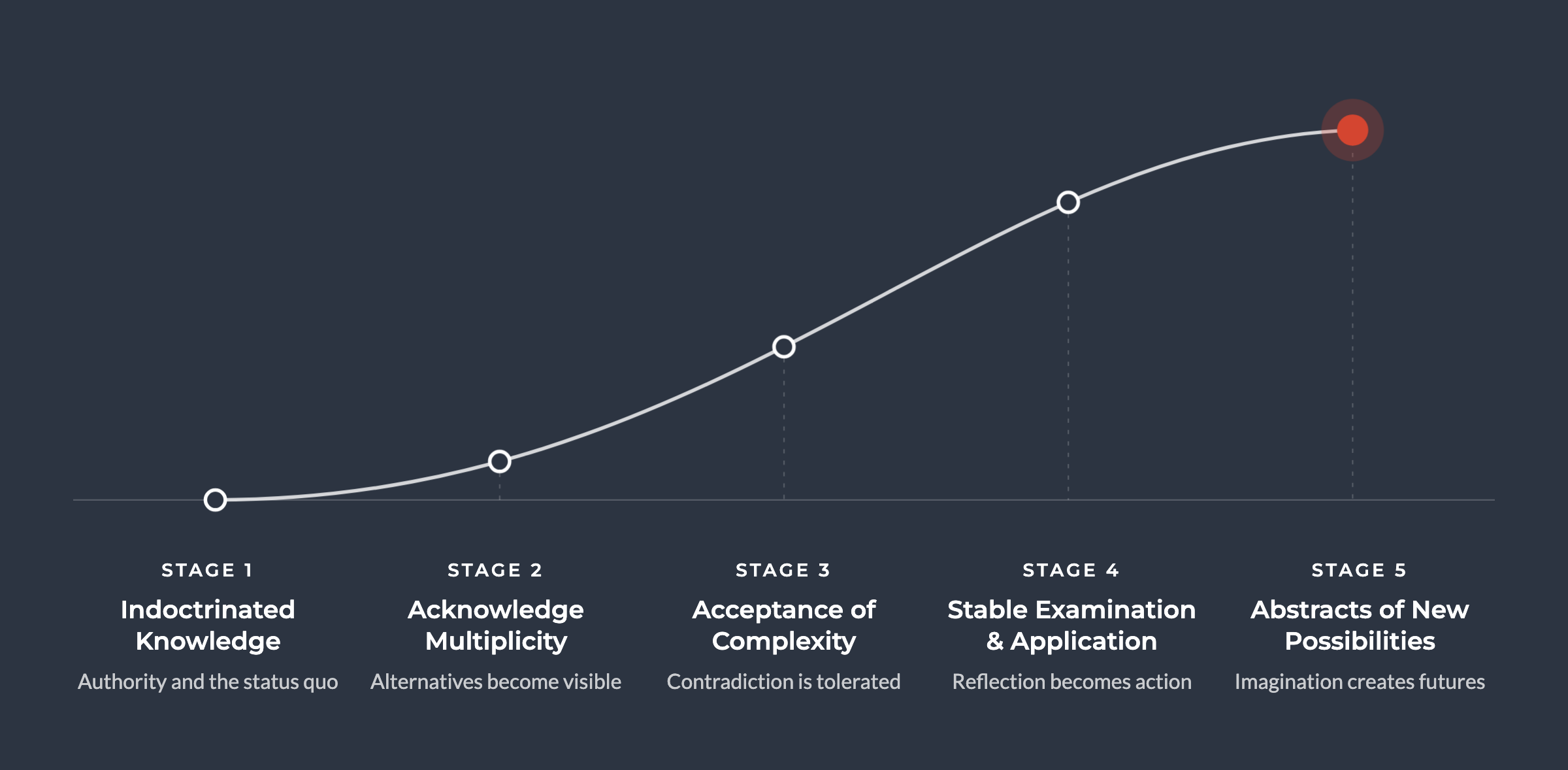
Grounded in Dr. Arthur Langer’s Fantasy Arc framework, the Institute investigates how people progress from indoctrinated knowledge toward “Abstracts of New Possibilities,” the highest stage of imaginative and reflective maturity, across the lifespan from K-12 through adult and executive education.
Reflection-Before-Action
The capacity to envision and evaluate future possibilities prior to implementation. Future societies require it, and it is what Stage 5 makes possible.
Core research agenda
Five research pillars
From K-12 through adult and executive education.

The Science of Imaginative Development
Develop validated developmental models measuring progression toward imaginative maturity.
AI and Reflection-Before-Action
Investigate how AI systems can support reflective, ethical, and imaginative cognition.

K-12 Imagination Development
Develop educational interventions that begin imaginative development at earlier ages.

Organizational and Societal Innovation Systems
Study how societies, governments, universities, and corporations cultivate imagination and innovation.

Humanities, Consciousness, and Creativity
Explore philosophical, psychological, and artistic foundations of imagination, extending Langer’s mapping of Jung, Rubin, Einstein, and Pythagoreanism onto the Fantasy Arc.
Intellectual foundation
Five claims the Institute is built on
Structure
Five divisions
Evidence-based systems that prepare future generations for the Imagination Age.

Laboratory for Cognitive and Imaginative Development
Developmental psychology
Learning sciences
Reflective maturity measurement

AI Futures and Human Development Institute
AI-enhanced cognition
Human-AI creativity systems
Ethical foresight

K-12 Innovation Studio
Curriculum development
Teacher training
School transformation

Organizational Imagination Lab
Leadership development
Corporate innovation
Institutional redesign

Humanities and Consciousness Research Center
Philosophy
Creativity
Ethics
Consciousness studies
Educational Deliverables
From Classroom to Boardroom

K-12
• Fantasy Arc curriculum modules.
• Creativity assessments
• AI-enhanced reflective learning systems
• Teacher certification programs

Higher education
• Graduate degrees in Imagination Studies
• Executive education
• AI and reflective leadership programs

Corporate education
• Innovation leadership programs
• Reflective decision-making systems
• Creativity acceleration labs